
How to Read a Utah Snow Ski Report: The Ultimate Guide
Unlock the secrets to the perfect Utah ski day. This guide explains how to read a Utah snow ski report, from decoding snow totals to checking canyon road conditions.
Reading a Utah snow ski report is the first step to planning a perfect day in the mountains. Understanding snow totals, road conditions, and avalanche forecasts helps you find the best powder, avoid traffic in the Cottonwood Canyons, and stay safe. This guide breaks down what to look for, when to check, and how to use the data to score an epic ski day.
What is a Utah Snow Ski Report?
A Utah snow ski report is more than a simple weather update; it's a real-time story of what’s happening on the mountain. It combines fresh snowfall data with the critical travel information you need to get to the resorts in Little Cottonwood Canyon and Big Cottonwood Canyon. A complete report gives you the crucial details to answer three key questions: Where is the best snow? What are the road conditions like? And what are the avalanche risks?
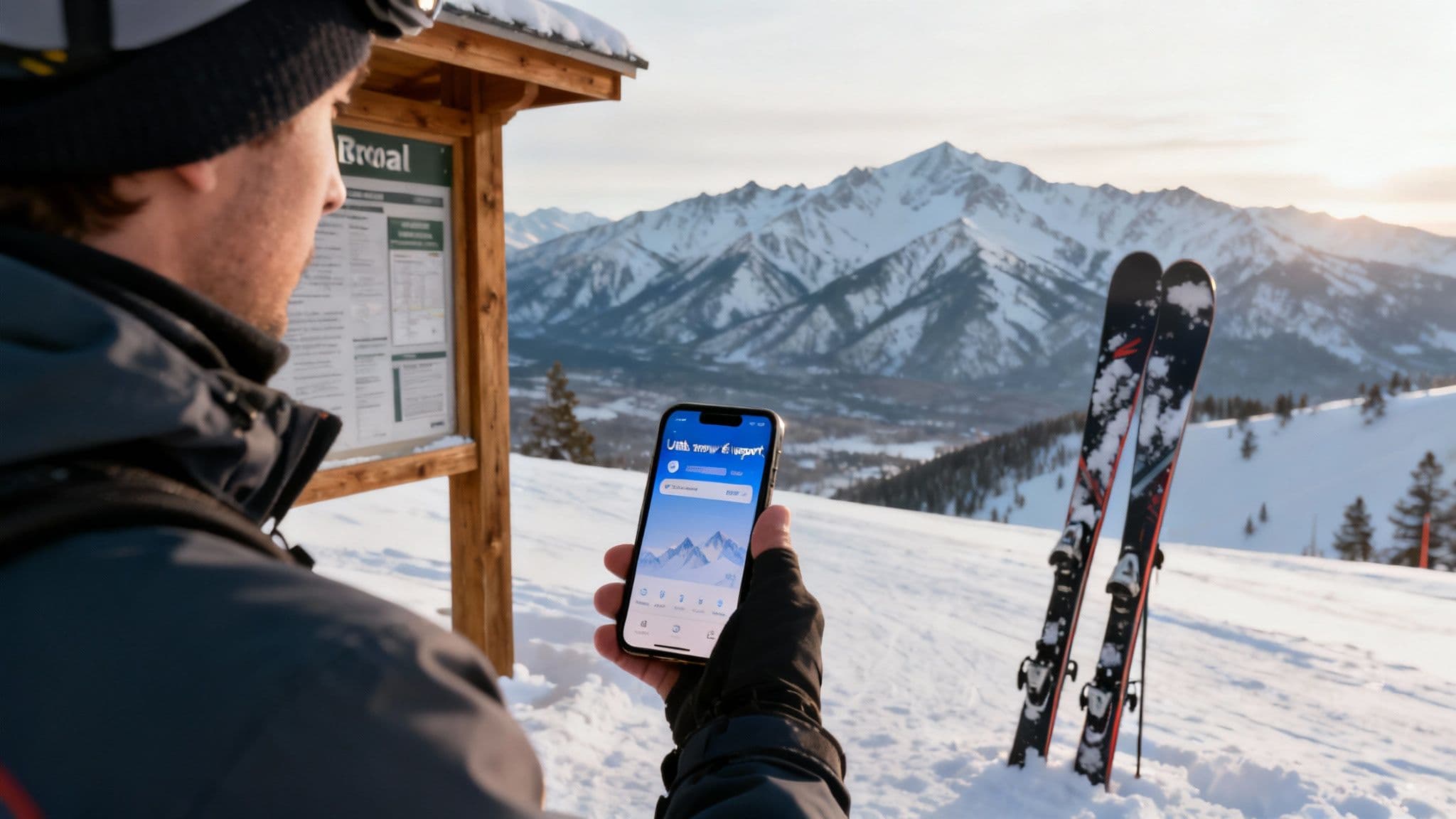
Why It's Important
Knowing how to interpret a snow report allows you to:
- Find the best conditions: Pinpoint which resort got the most snow and understand the quality of that snow.
- Travel safely and efficiently: Get live updates on road closures, traction laws, and traffic from the Utah Department of Transportation (UDOT).
- Stay safe on the mountain: Understand the daily avalanche forecast from the Utah Avalanche Center (UAC) and why certain terrain might be closed.
This guide will teach you how to analyze each component of the report, from snowfall numbers to the crucial details of the Wasatch snow forecast.
How to Read a Snow Report
To find the best ski day, you need to understand the data. A snow report contains key metrics that tell you about snow depth, quality, and what to expect on the slopes.
Decoding Key Snow Metrics
Here are the most important numbers and what they mean for your ski day:
| Metric | What It Means | Why It Matters |
|---|---|---|
| 24-Hour Snow | Fresh snow in the last day. | Your best indicator for finding untracked powder today. |
| Storm Total | Total snow from the current storm. | Shows how much the mountain has been refreshed over several days. |
| Base Depth | The settled depth of all snow. | Indicates overall coverage. A deep base covers hazards like rocks and stumps. |
| SWE | Snow Water Equivalent. | Measures moisture content. Low SWE means light, fluffy powder. |
Wasatch Roads Data Point: Our live data dashboards pull 24-hour snow totals directly from the resorts. When you see 14 inches at Snowbird on our site, that's the official report you can use to plan your morning.
For example, a report showing 3 inches in the last 24 hours but a 21-inch storm total means the best powder day was likely yesterday. In contrast, 12 inches in 24 hours with a 12-inch storm total means an epic day is happening right now. You can see resort-specific data on pages like our Snowbird snow reports.
Understanding Surface Conditions
Beyond the numbers, the report will describe what the snow feels like. Here are common terms:
- Powder: Fresh, light, untracked snow.
- Packed Powder: Skied-on or groomed powder. Still soft but not bottomless.
- Groomed: Slopes smoothed by snowcats, creating a corduroy surface.
- Variable Conditions: A mix of everything—powder, packed snow, and ice—on the same run.
- Wind-Scoured: Exposed areas where wind has stripped away fresh snow, leaving a firm or icy surface.
How to Check Road Conditions and Travel Times
Getting to the "Greatest Snow on Earth" means navigating the Cottonwood Canyons, which can be challenging during a storm. Checking road conditions is essential to avoid getting stuck or turned around.
When to Check
The best time to check road status is right before you leave home, typically between 6:00 AM and 7:00 AM on a powder day. UDOT often performs avalanche mitigation work early in the morning, leading to temporary closures.
Wasatch Roads Data Point: We provide live UDOT road status for Little Cottonwood Canyon and Big Cottonwood Canyon directly on our homepage. You can see in real-time if the traction law is in effect or if the road is closed.
Understanding Traction Laws
During storms, UDOT implements the Traction Law. This is a legal requirement.
- 4WD/AWD vehicles must have M+S (mud and snow) or snow tires.
- 2WD vehicles must have snow tires and carry chains.
Ignoring the law can result in a fine and being denied canyon entry. Our guide to UDOT Utah road conditions breaks this down further.
Local Tip: Always assume the traction law will be in effect on a powder day. Check your tires before the first big storm of the season to make sure they meet the requirements.
How to Use the Utah Avalanche Center Forecast
Even if you ski within resort boundaries, the daily forecast from the Utah Avalanche Center (UAC) is a critical part of your report. Ski patrol and UDOT use this forecast to make decisions about terrain openings and road closures.
Reading the Danger Scale
The UAC uses a five-level scale. Understanding it helps you respect rope lines and closures.
- Low (Green): Stable conditions.
- Moderate (Yellow): Heightened avalanche conditions on specific terrain features.
- Considerable (Orange): Dangerous conditions. Human-triggered avalanches are likely.
- High (Red): Very dangerous conditions. Travel in avalanche terrain is not recommended.
- Extreme (Black): Avoid all avalanche terrain.
Local Tip: Most avalanche accidents occur when the danger is "Considerable." This is because the risk is serious but not as obvious as "High," leading some to let their guard down. Always respect ski patrol's decisions, as they are based on this expert analysis.
A Step-by-Step Plan for Your Perfect Ski Day
Use this timeline to turn data into action.
The Night Before
- Check the Forecast: Look at the overnight weather from sources like NOAA to see how much snow is expected.
- Read the UAC Summary: Get an idea of the expected avalanche danger for the next morning from the UAC.
The Morning Of (6:00 AM – 7:00 AM)
- Check Snow Totals: Use Wasatch Roads to compare 24-hour snowfall at different resorts.
- Verify Road Status: Check our live UDOT data for closures or traction law updates for Little Cottonwood Canyon or Big Cottonwood Canyon.
- Confirm Avalanche Danger: Read the finalized morning UAC forecast.
- Make a Plan: Based on the snow and road data, choose your resort and decide on your departure time. The logistics for a powder day are similar to those for major international winter sports events, such as the Kekkonen Ski Race, where timing is everything.
FAQ: Utah Snow & Skiing
What is considered a "powder day" in Utah?
For locals, a true powder day usually means at least 8-12 inches of new, low-density snow overnight. Anything less is a "refresh"—great for softening up the slopes but not the bottomless experience Utah is famous for.
Why do the Cottonwood Canyons close so often?
Little and Big Cottonwood Canyons are two of the most avalanche-prone highways in North America. After a big storm, UDOT closes the roads to conduct avalanche mitigation, using explosives to clear unstable snow from the slopes above the road. This is a critical safety measure that prevents larger, natural avalanches.
When is the best time to ski in Utah?
For the deepest snowpack and most frequent storms, plan your trip between late January and early March. This window typically offers the most reliable powder conditions and ensures that most of the expert terrain across the resorts is open.